
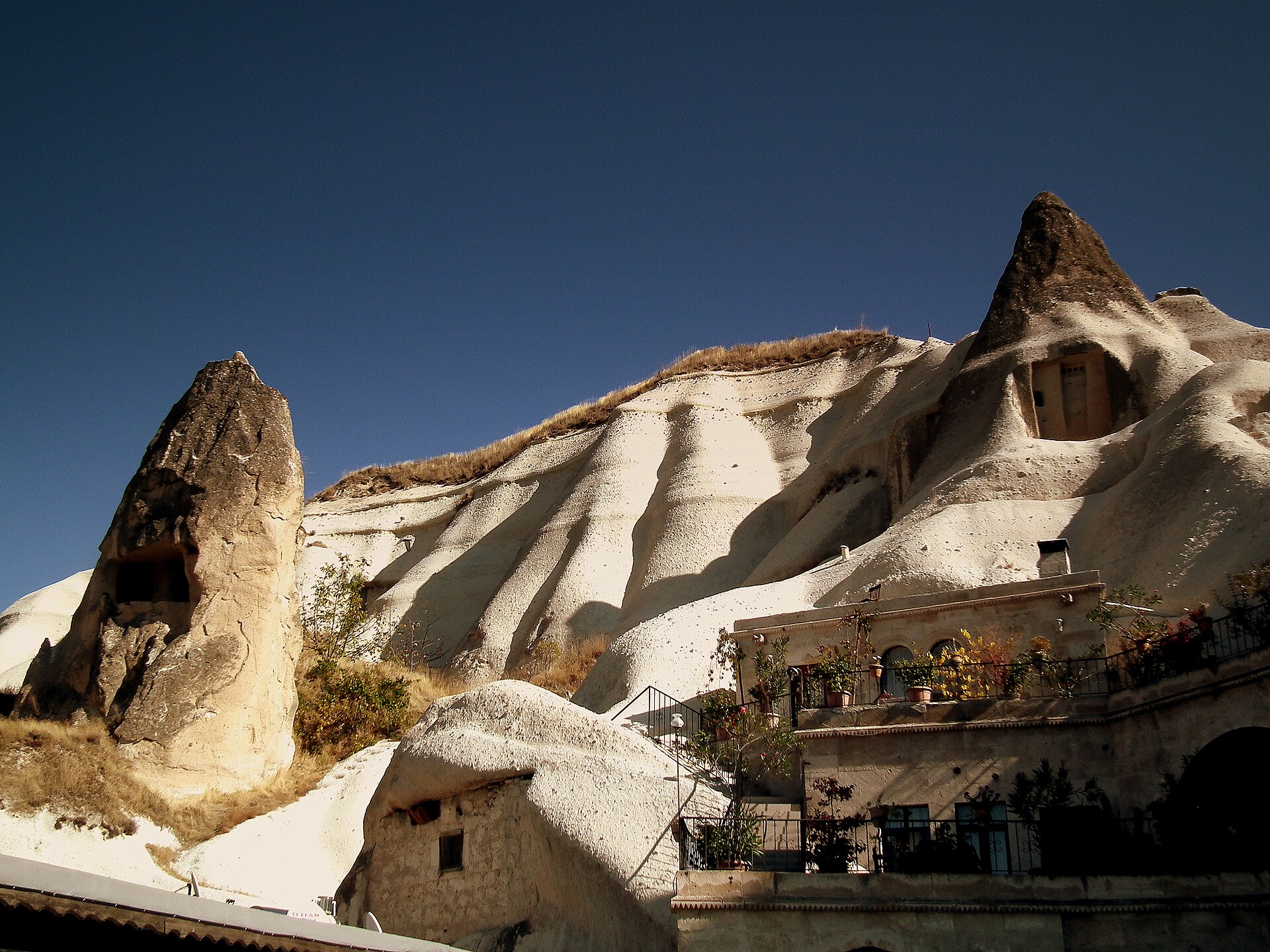
The tuff of Cappadocia is soft: it can be carved by hand, yet it hardens on contact with air. This is why the spaces here are not built but taken out — stone is not added, it is removed.
When volcanic ash collapsed and compacted millions of years ago, it left behind a porous rock called tuff. The people of the region noticed two of its qualities early: it was easy to carve, and once carved its surface hardened in the air. Safe, lasting and cool spaces followed.
The thermal behaviour of tuff still provides a comfort without equal. The mass of rock absorbs the heat of the day and gives it back slowly at night; the inside temperature stays within a narrow band all year. The need for air conditioning in summer and heavy heating in winter is therefore very low.
The method we used in restoration is the same as the traditional one. New surfaces were plastered with lime-based horasan mortar; no cement was used at all. Cement does not breathe, it traps the moisture inside the tuff and in time cracks the rock.
Light is the hardest matter in rock architecture. Instead of adding windows we followed the direction of the existing hollows; daylight enters the rooms at a different angle in the morning and the evening. Artificial light, rather than washing the walls, only brings out the texture of the surface.
The result of all this is rooms that do not imitate rock but are the rock itself. The chisel marks on the walls are the marks of hands that struck there centuries ago; we did not smooth them away.